

From the Lost Land: Schizo-Poem
by André Spears
Station Hill, 504 pp., $37.00
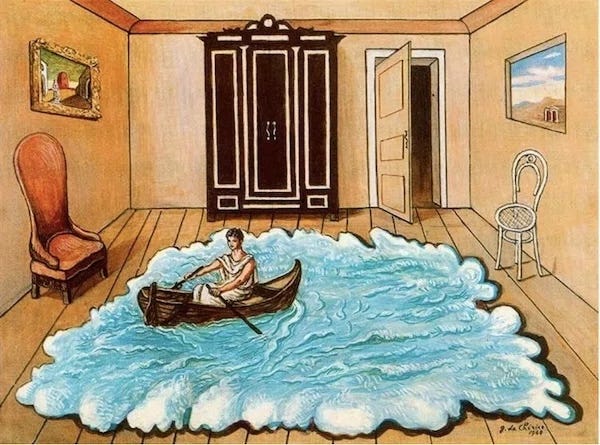
The psychic malady governing the last century’s greatest literature was neurosis: a nervous, depressive, or aggressive inability to conform to the regular demands of bourgeois life. Its sufferers—largely the daughters of middle-class families afflicted with a bewildering range of somatic symptoms and inner turmoil—sought a cure in the nascent science of psychoanalysis. The cure devised by Sigmund Freud and his collaborators in fin-de-siècle Vienna required analyst and analysand to collaborate on a narrative tracing each symptom to its root in the patient’s early trauma, generally an early experience of proscribed sexual desire felt within domestic life’s supposedly prim precincts. In psychoanalysis’s inaugural case study, written by Freud’s collaborator Josef Breuer, the patient Anna O. herself names this therapy “the talking cure,” because telling the physician stories about her own life alleviated her symptoms. Given psychoanalysis’s emphasis on narrative, language, and the psychic investigation of bourgeois repression, we might consider it a novel science in more ways than one. The narrative fiction contemporaneous with Freud’s new science—James, Proust, Joyce, Woolf, Faulkner—shared his interest in plumbing the modern individual’s consciousness to its forbidden depth in the mysteries of sexuality and desire.
By the late 20th century, however, with bourgeois domesticity increasingly liquidated by freer sexual mores, media proliferating to address ever narrower slices of the public, and a capitalism oriented toward the consumer’s self-expression rather the laborer’s self-denial, the psychoanalytic “depth” model of the psyche and its accompanying literary modes, such as the modernist novel of consciousness, began to look naïve and passé. Accordingly, French theorists Gilles Deleuze and Félix Guattari, in their 1972 manifesto Anti-Oedipus, declared, “A schizophrenic out for a walk is a better model than a neurotic lying on the analyst’s couch.” By schizophrenia, they meant not a possibly physiological pathology involving hallucinations and delusions, as the term is now clinically understood, but rather a condition of endless desire incited by what they called the “deterritorialized” flows of postmodern society with its rootlessness, its subcultures, and its endless consumption. A schizophrenic literature would correspondingly avoid the neurotic pursuit of deep psychic structures in a Proust or a Faulkner; schizo-literature would, rather, play along a textual surface of surplus and decentralized meaning à la the novels of Thomas Pynchon or the poems of John Ashbery.
I wasn’t sure how to introduce André Spears’s epic From the Lost Land: Schizo-poem, but a gloss on Spears’s own generic designation seemed most appropriate, if only to avoid the danger of a new reader’s confusing the poem for what is colloquially called a “schizo-post” online, i.e., a wild set of paranoid or hallucinated claims, usually political. (Spears’s poem encompasses this genre, too, as we will see, but is not reducible to it.) A theorist of “deep time” and its relation to literature, Spears has been at work on the poem since 2000, serializing and publishing pieces of it over the years multiple volumes, but this new edition from Station Hill Press gathers it into its final form: an experimental 21st-century epic of Homeric length and breadth giving innovative literary shape to the cultural chaos of our age.
The poem’s form could be called schizoid in the archaic clinical sense of the split or divided psyche. The text is laid out in two columns: one contains the poem’s narrative in short-lined free verse, while the other collects or constellates quotations from the entire history of literature, philosophy, religion, science, pop culture, political and social thought, and the magical and esoteric traditions. These fragments comment on the action and (in their juxtaposition) on each other. Chief among occult lore the poem broaches is its eponymous lost land, the fabled continent of Mu, as the scholar Miriam Nichols explains in her useful introduction to the book:
Mu, a legendary Atlantean world, now under the ocean, was “discovered” by Colonel James Churchward (1851-1936) on tablets he claimed to have accessed in India (The Lost Continent of Mu). Churchward made Mu the cradle of the world’s great civilizations. The Greek alphabet, he thought, referred symbolically to this lost continent. Churchward’s claims and others like it have been discredited on scientific grounds, but Mu, like Atlantis or Eden, has lived on in imagination.
The narrative itself is further doubled as two stories alternate between chapters, themselves presented as letters between the co-protagonists, S. and A., a couple in mourning for their dead child Es.
S. reports to A. about her service as navigator on a ship journeying either in outer space or on a vast ocean—Spears’s surreal narration favors the oneiric over the mimetic—and contending with such maritime or interstellar perils as hostile alien vessels and strange irruptions of nature. The ship’s large crew boasts a bevy of symbolically rich names, beginning with Captain Anna-O, who represents, perhaps, the 20th-century neurotic subject navigating the 21st century’s cultural, political, and technological shizoid disorder. (The crew also includes Tarzan, Venus, Möbius, Occam, van Rr’Ubik, and more, any one of which names could be explicated at length.) But Spears’s style of phantasmagoric storytelling no more allows for a coherent allegory than for novelistic depth of characterization. Like the epic journeyers of S.’s narrative, the reader is implicitly tutored to adopt the flexibility exhibited by the ship’s “Poetess,” Avon, presumably named to evoke the flow of Shakespeare’s native river and of Shakespeare’s own poetics:
She is able to span
all the moods:
Wonder, Courage,
Laughter and Love
are those she most often
returns to, but there are
times when she achieves
Peace of Mind,
evoking all of them at once.
But the poem’s ideological ambition surpasses this perhaps quiescent and venerable evocation of Shakespeare’s tolerance for ambiguity. S. and her shipmates, including Anna-O, also have to learn the healing power of a poetic social revolution as well:
[Anna-O] understood Mutiny
as a mode of therapeutic activity.
Her self-transformative insight
which she communicated
to the entire crew, and
her new knowledge of Nature’s
Oneness with a Cosmic
process of psychic renewal,
identified the becoming-
schizoid of the ship
as the work of Nature’s Revolt…
In other words, a nature violated and imperiled by human rapacity cunningly uses humans’ countervailing revolutionary impulse to repair itself by removing the agent of its injury, i.e., unjust political and economic practices. Stray lines throughout the poem, such as a pair about “Floating Dollar emerging / from the mists of Breton (sic) Woods,” implicate deregulated neoliberal capitalist economics as the proximate source of the global crisis Spears’s poem narrates. He also makes reference to today’s politics, especially the social-media enabled rise of right-wing populism and the rise of Trump.
Yet the poem persistently hints, as much through the quotations facing the story across the white space in the middle of each page, that neither Trump nor neoliberalism but rather something like an immemorial principle of masculine domination is what has rent and torn the world. Spears quotes from texts like Robert Graves’s The White Goddess and Ted Hughes’s Shakespeare and the Goddess of Complete Being, with their shared thesis that poetry is the extant practice of ancient goddess-worship extinguished by masculinist monotheism. This idea tends to leave the man as the poet, however, with woman as a passive receiver of worship rather than an agent of meaning, so Spears updates Graves and Hughes with extensive citations from modern and contemporary female poets from Emily Dickinson, H.D., and Laura Riding Jackson to Audre Lorde, Lucille Clifton, and Adrienne Rich. These lines from Rich’s “Notes Toward a Politics of Location,” which Spears quotes, may intimate the poem’s ultimate political desideratum:
Some of us . . . never meant anything less by women’s liberation than the creation of a society without domination; we never meant less than the making new of all relationships.
Meanwhile, in alternating chapters, A. remains on land, in a city where he quests for the best ouzo and plays Tarot games in Western-style saloons. It is a city no less wracked by unpredictable metamorphoses as S.’s ocean, as rioting youth “perform / Masturbation while uttering poems” and give birth to their own gender-swapped reincarnations in strange chambers. At the end of his landlocked journey, if anything weirder and less explicable than S.’s more seaworthy Odyssean epic, A. goes on a bike ride to hell where he, too, must unlearn the ideology of domination endangering life on earth:
The natural question I ask myself
is: How will I relinquish
my Essential Hold on win-win,
in favor of a new Essential
Hold on lose-lose,
without going through Torture?
As in Rich’s prose statement quoted above, Spears advocates the revision of all relationships, including those between human and non-human, away from domination (an obsession with winning) and toward an acceptance of our equal share in common need and vulnerability (an acquiescence in loss). With his Shakespearean commitment to ambivalent poetry over forthright propaganda, however, Spears does imply that this is easier said than done and may even involve torture for the individual.
In keeping with A.’s card games, the whole poem is divided into 22 chapters named for the Tarot’s major arcana, their figures often re-labeled to suit Spears’s symbolic or philosophical agenda. The card traditionally called the Chariot, for example, becomes “The War Machine,” a privileged term in Deleuzean philosophy for an anarchic force that challenges the settled order of the state. Several Tarot guides and studies quoted in the poem’s stream of citations note the major arcana’s journey from gendered division—with the Magician and High Priestess as first two cards, retitled the Illusionist and the Seeress in Spears’s book—to the World or Universe card’s androgynous figure dancing in integral cosmic wholeness. (And just as our female protagonist goes on a hero’s journey while our male protagonist remains on the home front, in defiance of gendered custom, so A.’s chapters tend to correspond to “feminine” cards and S.’s to “masculine.”) Tarot symbolism, then, provides an apt illustration and archetypal frame for the story Spears has to tell about how we might return to the Atlantean or Edenic lost land before power and avarice tore apart the oneness of nature.
I risk making the poem sound more didactic than “schizo,” for any definition of that word, because I find it is always valuable to spell out the human and emotional stakes of experimental literature, lest readers, in line with the prevailing populist paranoia Spears laments, pre-judge it a mere hoax. Readers are of course free to disagree with the poem’s implied argument: I myself am skeptical Spears’s apparent alliance of environmentalism, feminism, anti-capitalism, and revolutionary utopianism, since versions of these ideologies have been hegemonic in major institutions for at least half a century and have not succeeded in redeeming the world. On the other hand, I applaud Spear’s pursuit of these politics into metaphysical realms condemned as unserious or obscurantist by academe, as in his use of Tarot and other esoteric symbol-systems like Kabbalah, as well as his citations of figures like Jung, Crowley, and Graves. This openness to the spiritual could herald a new departure for a political left whose commitment since the 19th century to materialism has not delivered the utopian results Marxism promised.
Simply as a reading experience, though, From the Lost Land entertains (and occasionally, yes, exasperates) as a deliriously surreal journey through unexpected landscapes and wildly imaginative new vocabularies. Despite its storytelling impetus, this is a poetry that delights in the energy released when divergent lexicons collide:
Avon’s narrative followed
Tarzan through the Underworld
from the Satanic Swiss shores
of the Tohu Bohu River,
past the Arc of the Covenant,
to the Pentagon’s Thelema
Reserve—where Dioxide,
the Grand Wizard from
the Elders of Zion,
Awakened Tarzan’s FireEye
to the Black Budget
and net-zero Energy of
Spike Mutation and Maga.
Spears occasionally gives too much of the poem over to academic theorizing, as in passages like the following one, collaged together from Deleuze’s particular philosophical vocabulary:
The intensive de-territorialization
of the Mutineers’ war-machine
on a plane of immanence
become obvious with infinite speed
for all non-dreaming crew.
Still, like the science fiction it often cites—novels by Ursula Le Guin and Gene Wolfe and Octavia Butler and Samuel Delany—it is much more immediately pleasurable to read than the 20th century’s modernist and postmodernist epics, with their jagged and discontinuous shards of erudition, e.g., Ezra Pound’s Cantos and Charles Olson’s Maximus Poems, though these, too, are in its library of references. Unlike these 20th-century monuments, however, From the Lost Land cannot be decrypted in every particular, just as a Deleuzean schizophrenic cannot be appeased by the verbal formulae able to heal the Freudian neurotic.
We can at times only barely discern Spears’s story beneath the surface textual weave of disparate signifiers, which themselves don’t add up to a coherent allegorical meaning. Spears often generates the poem’s greatest suspense in the citational rather than the narrative column: what will he quote next? Or rather, what won’t he? There we find a truly “schizo” chaos of mutually resonant words by everyone from Plato to George Carlin, Omar Khayyam to Clarice Lispector, the Book of Mormon to Rachel Carson, Antonin Artaud to Jean M. Auel, Led Zeppelin to the Zohar, Hannah Arendt to the I Ching, Samuel Beckett to This Is Spinal Tap, Bob Dylan to Enheduanna (history’s first named poet). We read, as we scroll, in search of the next surprise, illumination, puzzle, or provocation. In this way, From the Lost Land, though it disparages online misinformation, mimics the schizophrenic experience of reading the feed and the screen more than it does reading an experimental or vanguardist book of the neurotic last century. This indulgence in internet aesthetics may contradict the poem’s utopian thesis about a lost and recoverable oneness, but then From the Lost Land would hardly be a “schizo-poem” if it were not somehow at odds with itself and therefore open to all the chaos of the life it seeks to render in words.
